Korea Fear Index: A Local Lens on Global Volatility (Why Korea Needs Its Own VIX: Unveiling the Korea Fear Index)
- 오리 오리
- Sep 2, 2025
- 4 min read

When global investors talk about “fear in the markets,” the VIX—often called the “fear index”—is usually the first chart that comes up. It reflects the expected volatility of U.S. equities and has become a global barometer of risk sentiment.
But here’s the catch: the VIX doesn’t always tell the full story for Korea. The Korean market reacts not only to Wall Street shocks but also to local pressures—ranging from exchange rate swings to regional geopolitical risks. Relying on the U.S. VIX alone can give investors in Korea a distorted picture of true market fear.
That’s why I built the Korea Fear Index, a composite measure combining Korea’s own volatility index (Korea VIX) with exchange rate fluctuations of the Korean won (KRW). It’s designed to capture what global investors miss: the uniquely Korean dimension of market sentiment.
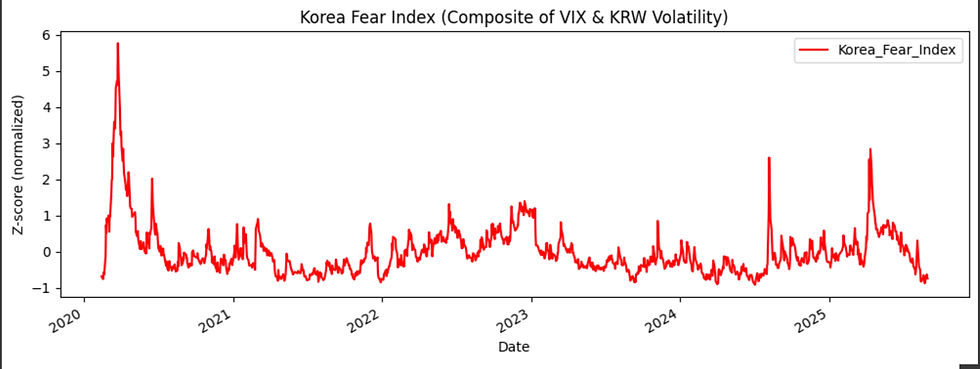
This chart makes an immediate impact, showing the Korea Fear Index spiking during crises like COVID and geopolitical tensions.
What Exactly Is the VIX?
The VIX, officially known as the CBOE Volatility Index, measures the market’s expectation of 30-day volatility in the S&P 500 index. In simpler terms, it tells us how “nervous” investors are about the near future.
Low VIX (10–15 range): Markets are calm; investors expect steady prices.
High VIX (20–40+ range): Markets are fearful; investors brace for turbulence.
The VIX is calculated from option prices, not from past stock movements. This is important because it reflects forward-looking expectations rather than historical volatility. That’s why traders call it the “fear gauge”—it reacts when investors rush to buy options as insurance against sudden losses.
While the VIX has become a shorthand for global investor sentiment, it was designed for the U.S. market. And that’s where the problem begins.
The Limitations of the U.S. VIX
The U.S. VIX is undoubtedly useful—it reflects global shocks such as the COVID-19 pandemic, the 2022 rate hikes, or geopolitical instability. However, when you overlay Korea’s VIX on top of the U.S. VIX, you notice moments of divergence.
During local currency stress events, Korea’s VIX often spiked higher than the U.S. counterpart.
In early 2025, for example, Korean volatility surged while U.S. VIX

This visualization shows how the two move together most of the time, but Korea has sharper local spikes.
This tells us that Korea has its own “fear triggers” that Wall Street doesn’t price in.
Adding the Currency Factor
Why bring KRW volatility into the mix? Because the Korean market is highly sensitive to foreign capital flows. When the won weakens sharply, it often signals foreign investors pulling money out of Korean equities. This creates a feedback loop: falling currency → falling stocks → rising volatility.

Notice how KRW volatility spikes coincide with major jumps in Korean VIX.
This is where the Korea Fear Index differs from the U.S. VIX: it integrates both stock market volatility and currency stress into one measure.
Building the Korea Fear Index
The methodology is straightforward but powerful:
Normalize Korea VIX, U.S. VIX, and KRW volatility into Z-scores.
Combine Korea VIX and KRW volatility into a composite line (the Korea Fear Index).
Interpret the spikes as moments of heightened Korean investor anxiety, distinct from the U.S. cycle.

The red composite line (Korea Fear Index) tracks common movements while amplifying moments when currency stress and stock volatility align.
How I Built the Korea Fear Index
To be clear, I didn’t create the VIX or even the Korea VIX itself. Both of those already exist:
The VIX is published by the CBOE based on S&P 500 option prices.
The Korea VIX is published by the Korea Exchange (KRX), based on KOSPI option prices.
What I did was to design a new composite indicator—the Korea Fear Index—by combining the Korean VIX with KRW currency volatility.
Here’s how I built it:
Collect data on Korea VIX, U.S. VIX, and KRW/USD volatility.
Normalize each series using Z-scores, so they’re comparable on the same scale.
Construct a composite index: Korea VIX + KRW volatility, averaged into a single line.
Interpretation: When both volatility and currency stress spike together, the Korea Fear Index rises sharply—signaling true panic in the Korean market.
This method adapts the logic of the U.S. VIX but tailors it to Korea’s unique vulnerabilities, especially its dependence on foreign capital flows and sensitivity to exchange rate movements.
Correlation with the U.S. VIX
Another interesting observation: the correlation between Korea VIX and U.S. VIX is not stable. Sometimes it’s strongly positive (moving in sync), but other times it even turns negative (moving in opposite directions).
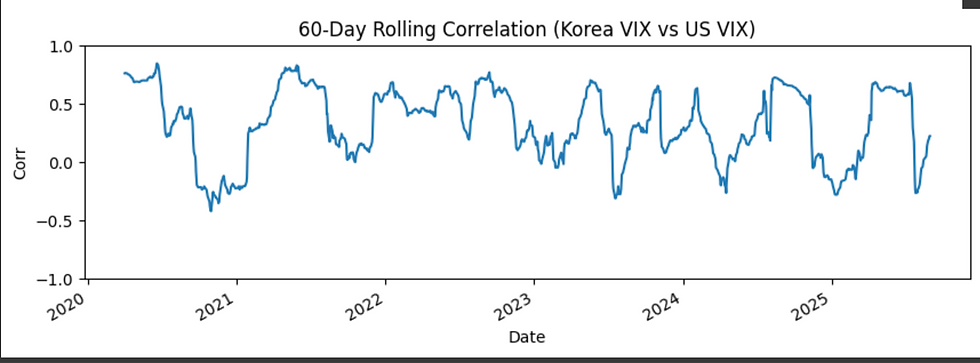
This chart highlights periods of decoupling—when Korean fear reflects something beyond Wall Street.
For investors, this means you cannot blindly assume that U.S. volatility explains Korean volatility. Local dynamics matter
Key Insights from the Data
Overreaction in Korea: The Z-score comparison shows that Korea’s VIX often spikes harder than the U.S. VIX during crises.

This reinforces the idea that Korean sentiment reacts more violently.
Currency as a Hidden Driver: KRW volatility may look smaller in scale, but its effect on sentiment is outsized.
Fear Has a Local Accent: While the U.S. VIX sets the global tone, the Korea Fear Index captures the uniquely Korean fear premium.
The Korea Fear Index is more than just a statistical experiment—it’s a practical tool for investors who care about Korean markets.
For global investors, it serves as a reminder that local risks matter even in an interconnected financial system.
For Korean investors, it’s a more honest mirror of market sentiment, reflecting both Wall Street shocks and local vulnerabilities.
As the global financial landscape grows more uncertain, watching the U.S. VIX alone is like checking the weather in New York to decide whether to carry an umbrella in Seoul. The Korea Fear Index provides the local forecast.


Comments